Exhibition "Vilenice"
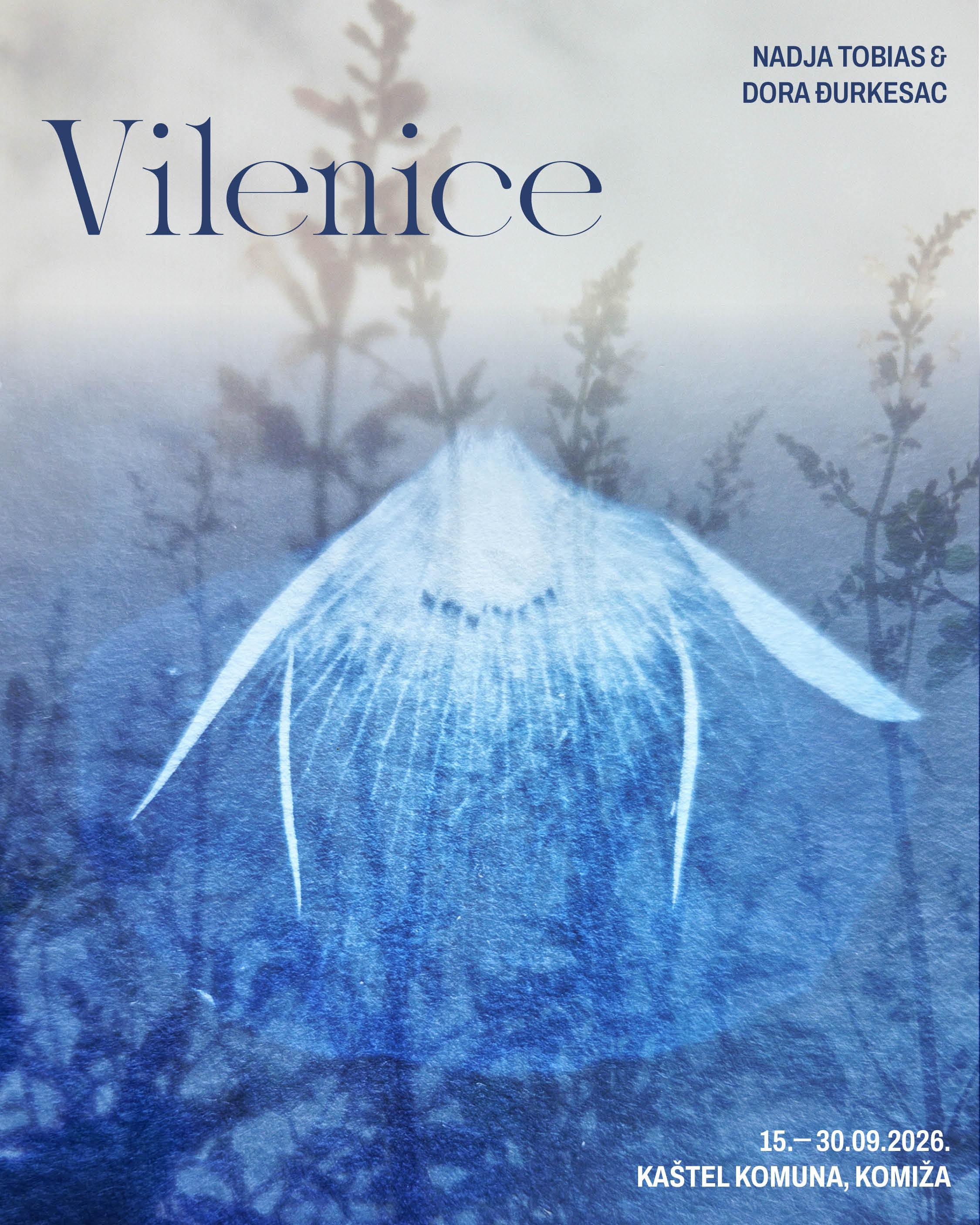
Vilenice
Nadja Tobias & Dora Đurkesac
15.9. - 30.9.2026.
Clock tower, Komiža
The first records of the appearance of vilenice (female healers associated with fairies) in Croatian territory, dating from 1634, come from Komiža itself. It was believed that fairies chose women to whom they passed on knowledge of medicinal plants, making them “guardians of plants” or herbalists. Among them were two Komiža herbalists and healers, Margarita and Lukrecija, whose practices were associated with the fairy cult.
Drawing on this local history, artists Nadja Tobias and Dora Đurkesac explore forms of female community, the transmission of knowledge, and the connections between the human and plant worlds in their exhibition Vilenice. The exhibition lies at the intersection of photography, herbal knowledge, and olfactory storytelling, while recalling forgotten practices of healing.
The central part of the exhibition consists of a series of photographs of women and plants, alongside works created using cyanotype, anthotype, botanical toning, chlorophyll printing, and the extraction of plant and earth pigments through chromatography. The photographic images are created with and from plants, which are considered not only as motifs but also as carriers of stories. Scent installations expand the visual narrative, incorporating bodily memory and the personal experience of the visitor.
Vilenice thus connects the local history of Komiža with contemporary artistic research, tracing the ways in which knowledge of plants, care, and healing has been passed down and transformed across generations—and exploring how this knowledge might be recalled and preserved today.
Biographies
Nadja Tobias (Kranj, 1980) is a photographer and visual artist based in Berlin. She holds a degree in Croatian Language and Literature and Comparative Literature from the University of Zagreb. Her practice explores analogue and experimental photographic processes, including cyanotype, pinhole photography, and camera-less photography, often connecting photography with nature, plants, and bodily experience. She is one of the founders of slow photography workshops on the island of Vis and the platform Menstrual Cyclic Nature, dedicated to education and destigmatising topics related to the menstrual cycle and reproductive health. Together with illustrator Ivana Pipal, she is the author of Prva, an illustrated educational story that approaches the experience of first menstruation from a holistic perspective and includes educational materials for understanding and tracking the menstrual cycle.
Dora Đurkesac (Zagreb, 1988) is an artist working at the intersection of contemporary dance, intermedia art, and design research. Her practice develops through poetic communities and sculptural, sound, and movement-based experiments, ranging from intimate gestures to collective formats such as herbalist collectives, performative protests, and floating exhibitions. Her work brings together movement, sound, plants, and experimental materials to explore relationships between the body, environment, and community. Her work has been presented nationally and internationally, with a particular focus on collective practices, herbalism, and ecological themes. Together with Nadja Tobias, she is a co-founder of slow photography workshops on the island of Vis.